When the Scrubs Don't Fit: The Surprising Link Between Uniform Sizing and Healthcare Worker Wellbeing
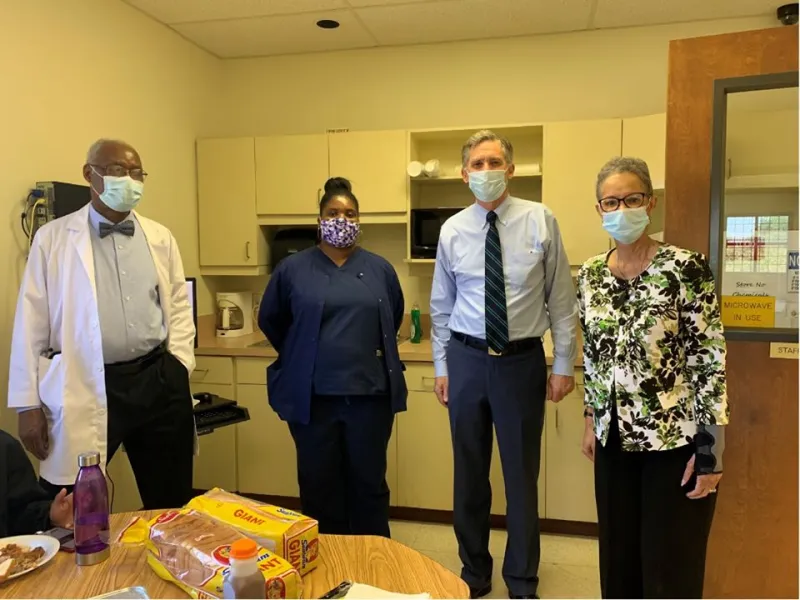
Photo: Office of French Hill, United States Congress, Public domain, via Wikimedia Commons
Every morning, millions of nurses, medical assistants, and clinical technicians across the United States pull on their scrubs and prepare for shifts that may last ten, twelve, or even sixteen hours. The uniform is often treated as an afterthought — a practical covering chosen for its color compliance with department protocols or its availability in a supply closet. Yet mounting evidence from occupational health researchers, ergonomic specialists, and the healthcare workers themselves suggests that the fit of that uniform may carry consequences far more significant than anyone in hospital administration has traditionally acknowledged.
At T&T Uniforms, we work closely with healthcare facilities of all sizes, from community clinics to large regional medical centers. What we hear consistently from frontline staff is telling: the wrong fit does not simply cause discomfort. It can actively compromise safety, accelerate physical fatigue, and contribute to the kind of job dissatisfaction that ultimately drives talented professionals out of the field.
The Physical Toll of a Poor Fit
Consider the mechanics of a nursing shift. A registered nurse may bend, lift, pivot, and reach hundreds of times over the course of a single workday. Each of those movements is influenced by the garments they are wearing. Scrub pants that are too long create a tripping hazard on slick hospital floors. A top that is too tight across the shoulders restricts arm elevation, placing additional strain on the rotator cuff during patient transfers. Conversely, a uniform that is excessively loose may catch on equipment, obstruct movement, or cause a worker to compensate their posture in ways that accumulate into chronic musculoskeletal stress.
Occupational health researchers have long studied the relationship between clothing and ergonomic performance. Studies published in journals focused on workplace safety have noted that constrictive or poorly proportioned garments can measurably reduce range of motion, forcing workers to adopt compensatory movement patterns. Over weeks and months, those patterns translate into repetitive strain injuries — the kind that account for a significant portion of workers' compensation claims in the healthcare sector each year.
Dr. Lena Marsh, an occupational therapist who consults with hospital systems in the Midwest, frames the issue plainly: "We spend considerable resources on ergonomic equipment — lift assists, adjustable workstations, anti-fatigue mats. But we rarely examine the clothing our staff wears, even though it is the one piece of equipment in contact with their bodies every moment of every shift."
Fatigue as a Systemic Problem
Beyond acute injury, the issue of fatigue deserves careful attention. Ill-fitting uniforms contribute to what researchers describe as "micro-stressors" — small but persistent physical irritants that compound over the course of a shift. A waistband that digs in after hours of bending. A neckline that chafes during a long documentation session. Fabric that does not breathe adequately in a warm clinical environment.
Individually, these discomforts seem minor. Collectively, they draw on a worker's cognitive and physical reserves, leaving them more depleted by the end of a shift than the demands of the work alone would explain. For a profession already grappling with burnout at historically high rates — the American Nurses Association has repeatedly flagged workforce exhaustion as a critical concern — the contribution of uniform-related fatigue is not trivial.
Healthcare administrators are increasingly recognizing that staff wellbeing is inseparable from patient safety. A fatigued or physically compromised nurse is more susceptible to medication errors, slower to respond to emergent situations, and less capable of the precise physical coordination that patient care demands. The uniform, in this context, is not a peripheral concern. It is part of the clinical environment.
The Retention Dimension
Staff turnover in healthcare is extraordinarily costly. Industry analyses have estimated that replacing a single registered nurse can cost a hospital anywhere from $40,000 to over $60,000 when recruitment, onboarding, and productivity loss are factored in. While compensation and scheduling are typically cited as the primary drivers of attrition, workplace comfort and dignity also play a meaningful role — particularly among newer professionals who have more mobility in the labor market.
Surveys of healthcare workers consistently reveal that uniform quality and fit rank among the practical concerns that influence job satisfaction. When staff feel that their employer has invested in providing them with functional, well-fitted professional apparel, it communicates a broader message: that the organization values their physical wellbeing and professional identity. Conversely, uniforms that are ill-fitted, uncomfortable, or visually inconsistent can subtly signal institutional indifference.
Marcus Ellison, a nurse manager at a large outpatient surgery center in Texas, made the decision two years ago to work with a uniform supplier to provide staff with properly sized, customized scrubs rather than a generic departmental issue. "The response was immediate," he recalls. "People came in prouder of how they looked. They were more comfortable. And honestly, I think it contributed to the team cohesion we built that year. It sounds simple, but it mattered."
The Case for Customization and Proper Sizing
The solution, while not complex, does require intentional effort. Healthcare facilities that prioritize uniform fit typically approach the issue in several interconnected ways.
First, they move away from one-size-fits-most ordering toward structured sizing programs that accommodate the genuine diversity of body types among their workforce. This means offering extended size ranges, petite and tall options, and in some cases, made-to-measure solutions for staff whose proportions fall outside standard sizing charts.
Second, they select fabrics engineered for clinical environments — materials with four-way stretch, moisture-wicking properties, and durability sufficient to withstand repeated industrial laundering without losing their shape or fit integrity.
Third, they incorporate customization elements that reinforce professional identity: embroidered department names or role designations, facility logos, and color-coded systems that allow patients and colleagues to quickly identify staff roles. These details serve both functional and psychological purposes, giving workers a sense of professional pride that generic uniforms cannot provide.
At T&T Uniforms, our healthcare apparel programs are built around these principles. We work with facility procurement teams and department managers to develop uniform standards that account for the real demands of clinical work — not just the aesthetic requirements of institutional branding.
Investing in the People Who Provide Care
The healthcare industry has, in recent years, made substantial investments in technology, infrastructure, and clinical protocols. The argument for extending that investment mindset to something as fundamental as the clothing worn by frontline staff is, upon reflection, straightforward.
A well-fitted, thoughtfully designed uniform reduces injury risk, diminishes fatigue, supports professional identity, and contributes to the kind of workplace satisfaction that retains skilled professionals. None of those outcomes are incidental. All of them affect the quality of care that patients ultimately receive.
The scrubs on a nurse's back are not a trivial procurement decision. They are, in every meaningful sense, a piece of clinical infrastructure — and they deserve to be treated as such.